HOW DOES A SYNTHESIZER WORK? The Journey From Electricity to Emotion
Before there was a melody, before there was a bassline, before there was a finished track, there was something much smaller. A vibration.
A simple electrical signal transformed into something that could move people. The synthesizer is one of the most fascinating inventions in modern music because it turned sound itself into something we could shape, explore and reinvent. It gave creators the ability to build instruments that never existed before, from deep electronic basses to futuristic textures that sounded like they came from another world. But a synthesizer is not just a machine full of knobs and buttons. It is an invitation to experiment. And that is exactly why, decades after the first synthesizers appeared, creators are still sitting in front of them, turning knobs, changing settings and discovering sounds they never expected to find.
The idea behind the synthesizer
The basic idea of a synthesizer is surprisingly simple. A traditional instrument creates sound through a physical movement. A guitar string vibrates, a drum skin moves, a piano hammer hits a string. A synthesizer creates sound differently.
Instead of starting with a physical object, it starts with electricity. An oscillator generates a repeating waveform, a basic electronic vibration. By changing and combining these waves, musicians can create completely new sounds. A simple signal becomes the foundation for endless possibilities. This idea changed music forever.
The building blocks of sound
Most synthesizers are built around a few important components.
Oscillator, creating the raw sound
The oscillator is where everything begins.
It creates the initial waveform, often a:
• Sine wave, a pure and smooth tone
• Saw wave, bright and powerful
• Square wave, sharp and digital sounding
• Triangle wave, softer and more rounded
At this stage, the sound is usually very basic. Almost like a blank canvas.
Filter, shaping the character
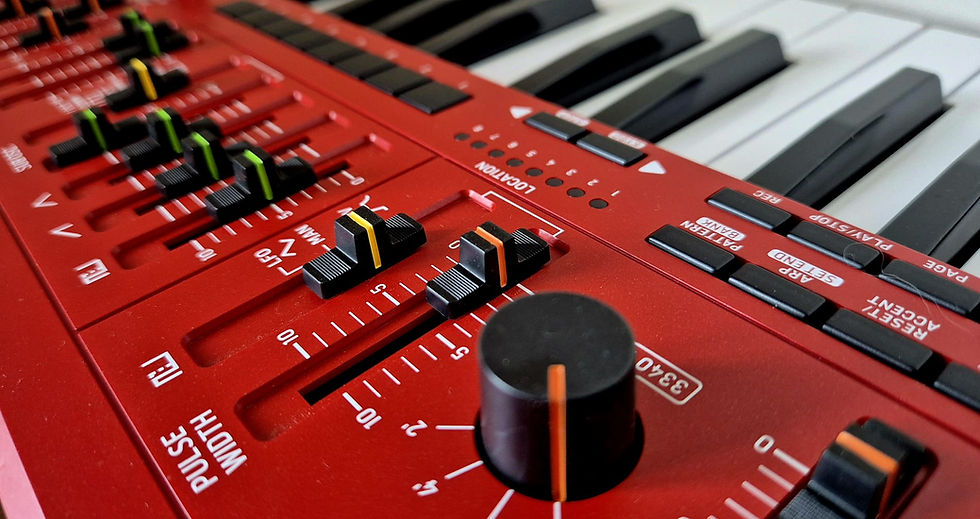
The filter is where the personality starts to appear. A filter removes or emphasizes certain frequencies. By turning a knob, a bright sound can become dark and warm, or a simple tone can transform into something aggressive and expressive. This is one of the reasons synthesizers feel so interactive. A small movement can completely change the emotion of a sound.
Envelope, bringing movement
A sound is not only about the notes themselves. It is also about how they evolve over time. The envelope controls this movement. The most common example is ADSR:
Attack, how quickly the sound starts. Decay, how it changes after the initial hit. Sustain, the level while the note continues. Release, how the sound fades away. This is what makes the difference between a sharp pluck, a long atmospheric pad or a powerful bass sound.
When creators discovered the real magic
The interesting thing about synthesizers is that many of their most iconic sounds were not created because someone followed a perfect formula. They came from exploration.
Creators experimented and pushed buttons. They connected things differently and they discovered. Electronic music history is full of moments where musicians found something unexpected and decided: "That sounds interesting. Let's keep it." The synthesizer became more than a tool. It became a creative partner.
From experimental machines to everyday creativity
Early synthesizers were expensive, large and mostly found in professional studios.
But technology changed. Companies like Roland, Moog, Korg and many others made synthesizers smaller and more accessible. Suddenly, more people could explore electronic sound creation. A teenager with a small synth could experiment in a bedroom.
A producer could create an entire world with a laptop and a few plugins. The tools changed, but the curiosity stayed the same.
Why synthesizers still inspire creators today
Today, synthesizers exist everywhere. Hardware machines, software instruments, modular systems, mobile apps. The possibilities are bigger than ever. But the reason people love them remains surprisingly simple. There is something special about creating a sound that did not exist before you touched the controls. That moment when a random experiment becomes an idea and a sound makes you smile. That moment when you think: "I made this." That is the real magic.
A synthesizer does not care how many followers you have. It does not care whether your track gets released. It does not know whether you are a beginner making your first sounds or an experienced producer with decades of experience. It only responds to curiosity. Every creator starts with the same thing: A blank sound, first experiment and a moment of discovery.
Because electronic music is not only about the final result. It is about the journey of finding something new. The joy of making.
Sources & further reading
Sources:
• Roads, Curtis. The Computer Music Tutorial. MIT Press.


